RESEARCH · National R&D project (KEIT)
Press-Die Polishing Automation
Press-Die Polishing Automation
Digital Twin & Mobile Manipulator
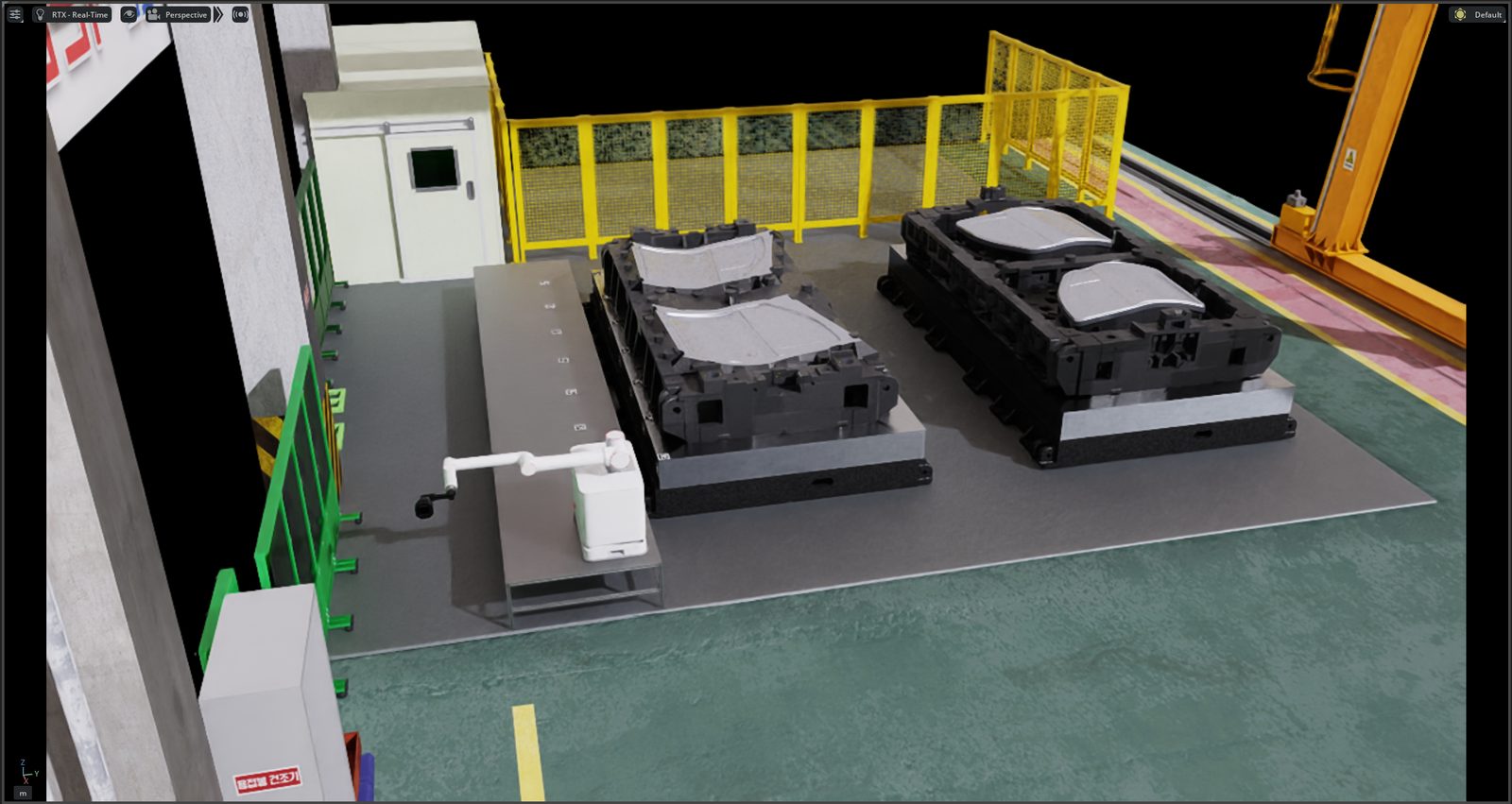
- 3D-scanned an automotive press-die factory and recreated it as an Isaac Sim digital twin to validate demo algorithms before going on site.
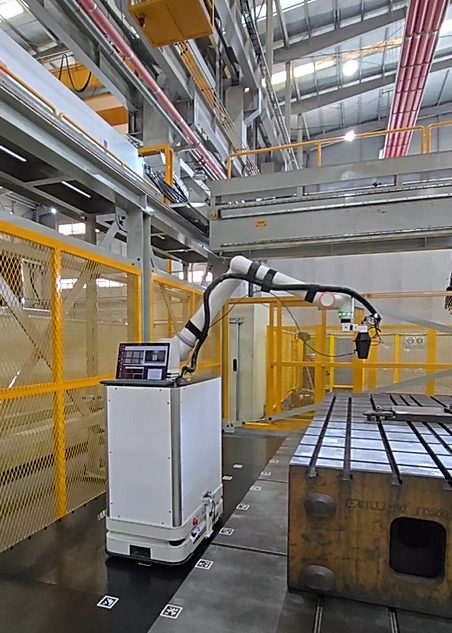
- Developed AprilTag-based mobile-platform localization and manipulator control, achieving 1 cm average repeatability error.
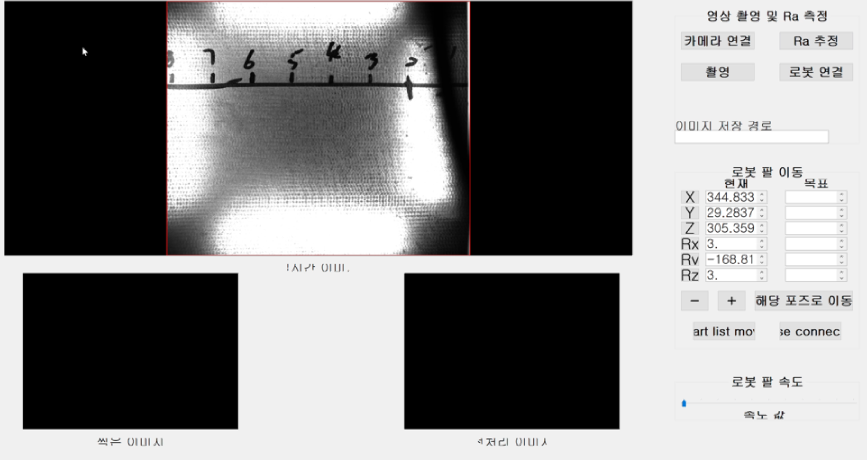
- A PyQt GUI made data collection ~50% faster, and a new surface-roughness (Ra) metric that removes valley outliers improved roughness estimation accuracy by ~10%.
STEP 1Digital twin of the factory
Site access was limited in this multi-organization project, so we scanned the factory and built a faithful digital twin in Isaac Sim. Core demo algorithms — driving paths, approach poses, inspection sequences — were validated in the twin before every site visit.
STEP 2Localization, control, and roughness estimation
- Localization — designed and implemented AprilTag-based localization for the mobile platform
- Manipulator control — Python-SDK-based control achieving 1 cm average (2 cm max) repeatability error
- Data collection — a PyQt GUI unifying specimen capture and roughness measurement, ~50% faster
- Roughness metric — proposed a new Ra computation that removes valley outliers, improving estimation accuracy by ~10%
ROLEYear-2 project lead
From the second year I served as the liaison across collaborating organizations and coordinated integration tests with field engineers. Demos were staged in three steps — simulation → test bed → real site — completing the integrated demonstration within the limited site-access windows.
RESULT
- Manipulator repeatability: 1 cm average error (2 cm max)
- Data collection ~50% faster · roughness estimation accuracy ~10% higher
- Three conference papers on surface-roughness estimation (KSME 2024)


